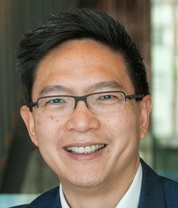
Professor Elgene Lim
Professor Elgene Lim is a medical oncologist and researcher with a focus on breast cancer research and treatment, and the Principal Cancer Theme Lead at the Faculty of Medicine, UNSW Sydney, and the inaugural National Breast Cancer Foundation Endowed Chair. He completed his doctoral research, medical and oncology training in Melbourne. Findings from his PhD research under the mentorship of Geoffrey Lindeman and Jane Visvader at the Walter and Eliza Hall Institute, had a major impact on the identification of the culprit cells in carriers of the BRCA1 mutant gene, a hereditary breast cancer syndrome. He subsequently furthered his research and clinical training at the Dana-Farber Cancer Institute and Harvard Medical School under the mentorship of Eric Winer and Myles Brown, both internationally acclaimed leaders in breast cancer research and clinical trials, through fellowships from the Fulbright Foundation, National Health and Medical Research Council of Australia, and Royal Australasian College of Physicians.
Elgene currently oversees the breast oncology unit at The Kinghorn Cancer Centre, St Vincent’s Hospital in Sydney. He also heads the Connie Johnson breast cancer research laboratory at the Garvan Institute of Medical Research. In partnership with their patients, their research spans the laboratory to clinical trials. The laboratory performs clinically focused research, including the evaluation of novel therapies, and overcoming resistance to hormone receptor positive breast cancers. Their research is funded through Cancer Australia, NHMRC, Cancer Council NSW, and the National Breast Cancer, Love Your Sister, White Butterfly, Balnaves, Curran Foundation and Garvan Research Foundation.
Elgene also seeks to improve healthcare more globally. At a local level, he volunteered as a physician to asylum seekers without access to Medicare. He currently works with the Asha Kiran Hospital in Orissa, India, on a longer-term strategy of expertise transfer and partnership with local doctors.
Awards
- 2022
Cancer Council NSW Sally Crossing Award
- 2021
Principal Cancer Theme Lead - Faculty of Medicine - UNSW Sydney
- 2017
National Breast Cancer Foundation Endowed Chair
- 2016
Thelma Greig Cancer Award - St Vincent's Clinic Foundation
- 2015
Connie Johnson/Love Your Sister Award
- 2014
National Breast Cancer Foundation Practitioner Fellowship
- 2014
Ramaciotti Research Award
- 2013
Claudia Barr Adams Award - Dana-Farber Cancer Institute
- 2012
American Association of Cancer Research Scholar in Training Award
- 2011
National Health & Medical Research Council Overseas Biomedical Postdoctoral Fellowship
- 2010
Fulbright Victoria Fellowship.
- 2009
Edith Moffatt Award - Walter & Eliza Hall Institute
- 2009
JJ Billings Research Fellowship - Royal Australasian College of Physicians
- 2008
Early Career Bench to Bedside Collaboration Award - Victorian Cancer Agency
- 2008
Glaxosmithkine Postgraduate Award
- 2007
Australian Stem Cell Research Center Postgraduate Award
- 2007
Clinical Oncology Society of Australia Tumour Targeting Fellowship
- 2006
National Breast Cancer Foundation White/Zaal Postgraduate Scholarship
- 1997
Prize for Best knowledge - Singapore Armed Forces Officer Cadet School
- 1990
M Patrick Callinan Academic Prize - St Mary’s College - University of Melbourne
Selected publications
See all publications- PUBLISHED 19 August 2026Breast (Edinburgh, Scotland)
Leveraging endocrine sensitivity in ER-positive DCIS: Neoadjuvant therapy and nonoperative management
- PUBLISHED 12 August 2026Nature
Rb-driven transcription limits its tumour-suppressive effects in breast cancer
- PUBLISHED 21 July 2026NPJ Breast Cancer
The WinPro trial: window-of-opportunity study of endocrine therapy with micronised progesterone in ER-positive breast cancer
- PUBLISHED 1 July 2026Cancer Research Communications
Stromal Cell Subsets Modulate T-cell Infiltration in Early Breast Cancer
- PUBLISHED 8 June 2026NPJ Breast Cancer
SERENA-6 interpretation and clinical implications: intercepting endocrine resistance in metastatic breast cancer